
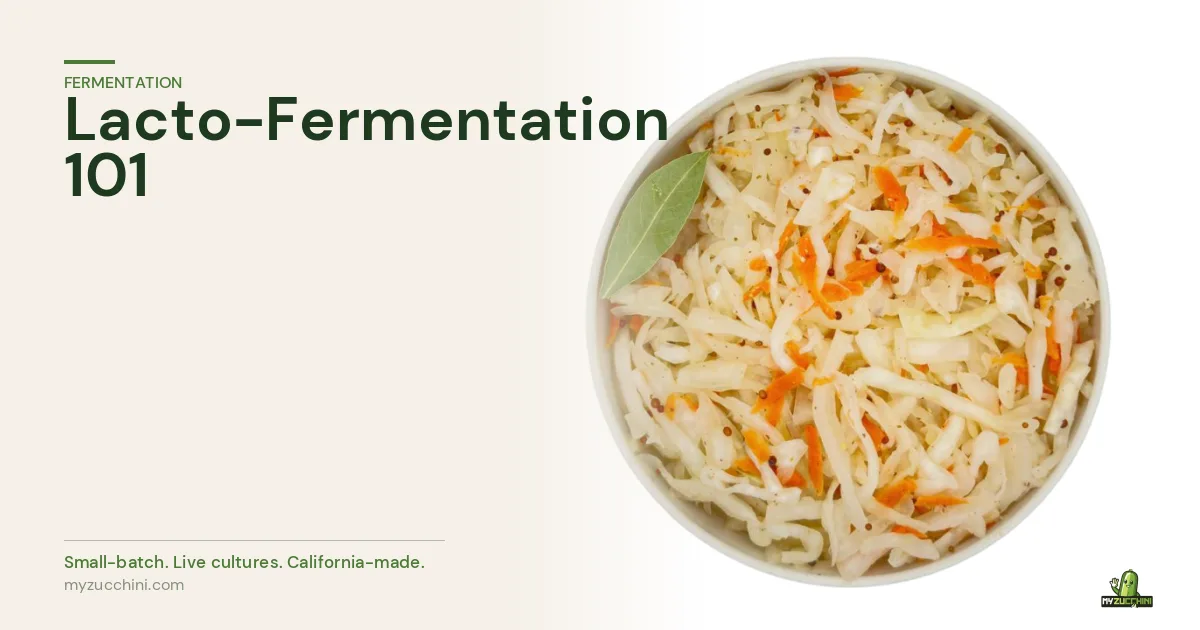
Lacto-fermentation is one of humanity’s oldest food preservation techniques, practiced for thousands of years across every continent. Yet most people who eat fermented foods regularly have never seen the process explained clearly. Here’s what’s actually happening in the jar — from day one through the finished product.
The Three Ingredients
Lacto-fermentation requires only three things:
- Vegetables — the substrate for fermentation and the food source for bacteria
- Salt — which selects for beneficial bacteria while inhibiting harmful ones
- Time — to allow the fermentation process to complete
No vinegar. No heat processing. No starter culture (though some recipes use whey or a brine from a previous batch). The bacteria that drive lacto-fermentation are naturally present on the surface of fresh vegetables — and their population explodes under the right conditions.
The Microbial Sequence
Lacto-fermentation unfolds in distinct phases:
Phase 1: The Setup (Days 1–2)
When you combine vegetables and salt, two things happen simultaneously. The salt draws water out of the vegetable cells through osmosis, creating a natural brine. It also selects against harmful bacteria and molds that cannot tolerate salt, while beneficial Lactobacillus species — which evolved to withstand salt — begin to thrive.
Phase 2: Active Fermentation (Days 3–10)
Lactobacillus bacteria consume the natural sugars (primarily glucose and fructose) in the vegetables and produce lactic acid, carbon dioxide, and small amounts of acetic acid. The rising acidity (falling pH) further suppresses harmful microorganisms and signals the environment is becoming hostile to them. You’ll see bubbles — that’s CO2 escaping — and the brine will become cloudy. This cloudiness is beneficial bacteria in suspension, not spoilage.
Phase 3: Maturation (Days 10–30+)
As acidity increases, the dominant bacterial species shift. Early-stage bacteria give way to more acid-tolerant species. The flavor develops complexity — from initially bright and sharp to rounded and deep. The texture softens slightly as enzymes break down plant cell walls. The vegetable is now a different food than when it started: preserved, alive, and nutritionally transformed.
Why Salt Concentration Matters
Salt percentage is one of the most critical variables in lacto-fermentation. Too little salt (below about 1.5% by weight) and harmful bacteria or yeasts can take hold before beneficial bacteria establish dominance. Too much salt (above 3%) and the fermentation slows dramatically or stalls.
Most traditional recipes fall between 2% and 2.5% salt by weight of the vegetables. This range consistently produces safe, reliable fermentation while allowing Lactobacillus species to thrive. At MyZucchini, we follow traditional salt ratios refined over years of small-batch production in Sacramento.
Temperature and Fermentation Speed
Fermentation speed is directly tied to temperature. Warmer environments (70–80°F / 21–27°C) produce faster fermentation, often within one to two weeks. Cooler environments (60–68°F / 15–20°C) produce slower, more complex fermentation — sometimes over four to six weeks — with a more developed flavor profile.
California’s Mediterranean climate makes for interesting seasonal variation in fermented foods. Summer batches ferment faster and develop a bolder flavor; winter batches are slower and often more nuanced.
What Happens to the Vegetables?
Beyond the microbial activity, fermentation changes the vegetable itself:
- Antinutrients are reduced. Phytates and oxalates — compounds that bind to minerals and reduce absorption — are broken down by bacterial enzymes.
- New nutrients are created. B vitamins and vitamin K2 are produced as bacterial metabolites.
- Vitamin C is preserved. Unlike heat processing, fermentation preserves heat-sensitive nutrients.
- Digestibility improves. Pre-digestion of complex carbohydrates and proteins makes fermented vegetables easier to digest than their raw counterparts.
Traditional Craft, Modern Understanding
Cultures around the world discovered lacto-fermentation independently — Korean kimchi, German sauerkraut, Eastern European pickles, Indian achar. The science has only recently caught up with what these traditions understood intuitively: fermented vegetables are more than preserved food. They are living food, and they carry real benefits for the people who eat them consistently.
Every vacuum-sealed bag of MyZucchini fermented vegetables is made following these traditional principles — vegetables, salt, time, and craft — in small batches in Sacramento, California.
Related Reading
- Fermented vs. Pickled: What’s the Difference?
- Fermented Hot Cabbage: The Probiotic Powerhouse
- Fermented Pickles vs. Vinegar Pickles
Shop MyZucchini Products